 Ticko
Try Ticko for the two minutes
Ticko
Try Ticko for the two minutes
When a child won’t brush their teeth
Almost every family hits this at some point: the toothbrush comes out and the child clamps their mouth shut, goes limp, or simply runs. It is exhausting, it happens at the worst hour of the day, and it tends to make parents feel like they are doing something wrong. Usually they are not — the resistance is developmentally normal, and it responds far better to structure than to pressure.
General information for parents, based on the sources listed below. It is not medical advice — ask your dentist about your own child.
Why children refuse
Refusal is rarely about the teeth. Three causes cover most of it, and they need different responses.
- Control. Brushing is one of the few things done to a small child rather than by them. Refusing is often the only lever they have, and the harder you push the more valuable that lever becomes.
- Sensation. Mint stings, foam feels strange, bristles on gums can genuinely hurt, and a toothbrush at the back of the mouth triggers the gag reflex in a lot of children.
- Timing. Brushing lands at the end of the day, when a tired child has no reserves left. The same child who fights at 8pm will often brush without comment at 7am.
Seven things that help
None of these are magic on their own. Two or three together, kept up for a couple of weeks, is usually what turns it around.
- Give them a real choice, but a narrow one. Not "do you want to brush?" but "the blue brush or the red one?" and "you first or me first?". The choice is genuine; the brushing is not optional.
- Move it earlier. Brush before the bath, or before the last story, rather than as the final thing before sleep. A less tired child argues less.
- Let them brush first, then you finish. Children under about seven cannot clean their own teeth properly, but they very much want to try. Let them go first, then take a turn to get the bits at the back.
- Change the toothpaste. A non-mint, non-foaming children’s toothpaste removes the single most common sensory objection. Check it still contains fluoride at the level for their age.
- Brush your own teeth beside them. Modelling works better than instruction at this age, and it turns the moment from a procedure into something the family does together.
- Make it visible. A wall chart, stickers, or an app that shows progress gives a child a reason to come back tomorrow that is not "because I said so".
- Stop negotiating during the event. Decide the rule outside the bathroom, then be calm and boring about it in the moment. Arguments are attention, and attention rewards the argument.
What the guidance actually says
It helps to know which parts are worth insisting on and which are not. The NHS guidance is short and specific:
- Brush twice a day for about two minutes, and make one of those the last thing before bed.
- Up to age three, an adult should do the brushing, using a smear of toothpaste containing no less than 1,000ppm fluoride.
- From three to six, let the child brush while you supervise, with a pea-sized amount of 1,000–1,500ppm toothpaste.
- From seven, most children can brush for themselves — but it is still worth watching.
- Spit out after brushing and do not rinse. Rinsing washes away the fluoride that does the work.
- Take a child to the dentist when their first teeth appear, or before they turn one.
The two minutes matter more than perfect technique at this age. A child who brushes twice a day imperfectly is in a far better position than one who brushes brilliantly on the three nights a week you win the argument.
When to ask a dentist
Persistent refusal is usually behavioural, but not always. Book an appointment if your child complains of pain, flinches from one specific spot, has visible white or brown marks on a tooth, or if the refusal started suddenly in a child who used to be fine. A dentist can also show a reluctant child what is going on in a way that lands differently coming from someone who is not their parent.
Where an app fits
A brushing app is not a substitute for supervision, and it will not fix a sensory problem or a toothache. What it can do is carry the two minutes and give the child a reason to start.
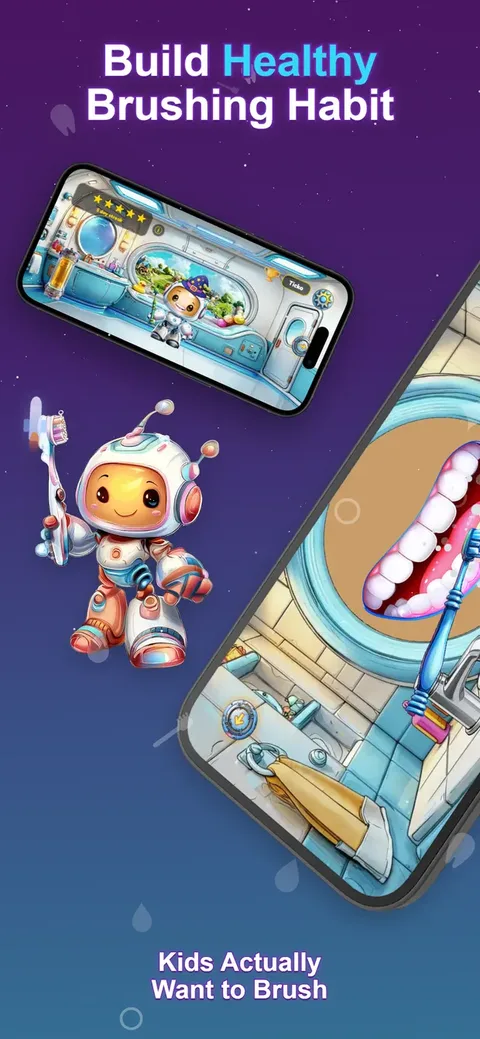
That is what we built Ticko for: a two-minute timer with a visual tooth map, a friendly robot leading each zone, and a cartoon episode unlocked at the end. The reward comes after the brushing, not before, and the daily streak is what most parents tell us keeps the routine alive past the first week. It is free, has no ads, and works offline.
Questions parents ask
Is it normal for a three-year-old to refuse to brush?
Yes. Around three is the most common age for it, because it coincides with a stage where asserting control matters enormously to a child. It usually eases with a predictable routine and a narrow choice, rather than with more pressure.
Should I hold my child down to brush their teeth?
Force works once and costs you the next hundred nights. If a child is genuinely distressed, stop, and try a different time of day, a different toothpaste, or letting them brush first while you finish. If nothing works over several weeks, speak to your dentist.
What if my child only brushes for thirty seconds?
Thirty seconds every day beats two minutes once a week. Build the habit first and extend the time afterwards — a timer with something to look at makes the extra ninety seconds much easier to hold.